Python Turtle Yin Yang
One big half circle and two small ones bend into the S, then two small dots.
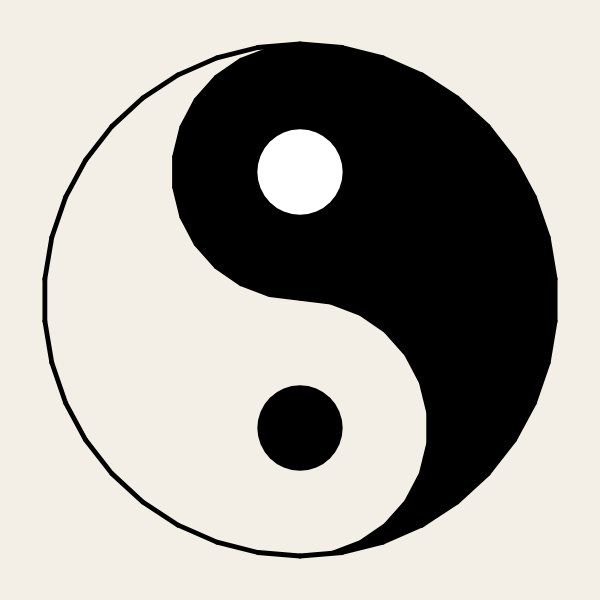
The full code (32 lines)
import turtle

screen = turtle.Screen()
screen.bgcolor("#f3efe6")
t = turtle.Turtle()
t.hideturtle()
t.speed(0)
r = 160

# the black half: a big half circle and two small ones make the S
t.penup()
t.goto(0, -r)
t.setheading(0)
t.pendown()
t.color("black")
t.begin_fill()
t.circle(r, 180)
t.circle(r / 2, 180)
t.circle(-r / 2, 180)
t.end_fill()

# the outline
t.setheading(0)
t.pensize(3)
t.circle(r)

# two dots: white in the black, black in the white
t.penup()
t.goto(0, r / 2)
t.dot(r / 3, "white")
t.goto(0, -r / 2)
t.dot(r / 3, "black")
How it is drawn
From the bottom (0, -r), facing right, circle(r, 180) goes up the right side to the top.
circle(r / 2, 180) bends left to the centre, circle(-r / 2, 180) (a negative radius bends right) back to the bottom. The three arcs enclose the dark half.
With a positive radius circle turns left, with a negative one right — that pair makes the S.
Last, t.dot(r / 3, color) puts a dot at each small circle's centre.
Questions
Why setheading(0) before the outline?
After the dark half the turtle faces left; circle(r) would then draw a circle below instead of around.
What does a negative radius do?
circle(50) goes round to the left, circle(-50) to the right: the same size, bent the other way.
Try another
 SpirographThree numbers, endless patterns
 Sierpinski triangleA triangle full of holes
 ClockIt tells the time
 SnowflakeThe Koch curve, folded finer and finer
In the tutorial: Yin and yang →All turtle examples →Python playground →